Article: Greta Laundy: Elemental to Ethereal
Greta Laundy: Elemental to Ethereal

Greta, when we first came across your work we were immediately enamored by it. Each piece radiates and invites you in. How did you get started down this creative avenue?
I’ve always been a creative person, as a child I lived in a very imaginary world and I don’t think I’ve entirely lost that childlike wonder for the world. When I left school I knew I wanted to study visual arts and make this my life’s profession. I gained a Bachelor of Visual Arts with 1st Honours while working and raising a family and have been professionally exhibiting for many years now. I also completed a Master of Teaching and taught visual arts to children, teenagers and seniors. For the last five years, I’ve been incredibly fortunate to dedicate my whole time to my painting practice in my home studio.
I haven’t lost that childlike passion for exploring my creativity and sharing it.

While the works boast explosions of color, they still feel natural. How much of an impact does the environment have on your work?
I grew up on farms in the country until I was 17 years old and that exposure to the cycles of nature has had an enormous impact upon my arts practice. The places where I feel most at peace are in the natural environment. I highly value protecting nature as without healthy ecosystems all living things suffer.
Your work takes the elemental to the ethereal. Can you describe your process?
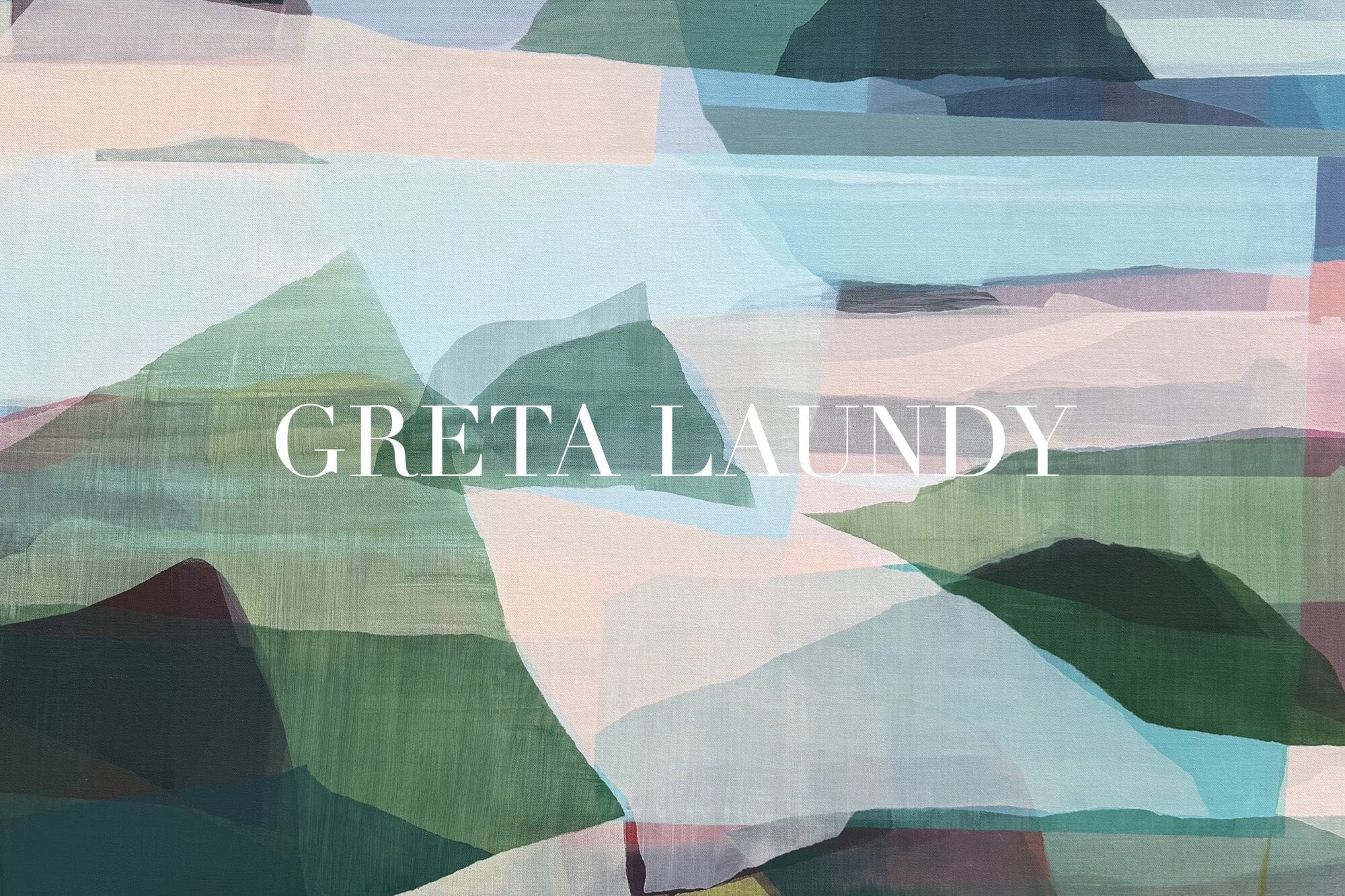
I begin by simply choosing colours that I want to explore, and these can be quite clashing such as lavenders and lime greens (I love using complementary colour). My purpose in the initial stage is to cover the canvas and create a surface that I can respond to. I use mainly scrapers and quick methods of paint application in the early stages as I know this will in all likelihood be overpainted.
There will be a point where the work is very messy and is a bunch of marks and layers. At this point the real work begins with a series of questions which respond to the surface: “What is drawing my interest?”, “What do I want to cover or keep visible?”, and then as I address this the work will begin to talk to me, it will begin to take its own shape. From there, I begin to draw out the composition more, constantly pushing and pulling the surface with tone, colour, and shape with the intention on keeping the work in a state of flux, where the eye shifts across the surface discovering more, getting lost, coming back to a different point. My aim is to create a sense of the landscape without being too descriptive. I want there to be room for the viewer to interpret the work through their own lens as well.
I’m pretty rigorous in the critiquing process and if the work becomes too resolved I will often begin again. This is painful in many ways, but ultimately, I need the work to inspire me and feel fresh.
Importantly, I use incredibly thin and transparent paint layers after the initial underpainting, some works may have up to 100 layers. This creates a beautiful luminosity and dreaminess which I love from a conceptual and technical point of view. Everything I do is intuitively generated.

Your work has evolved over the years. How did you end up in this current state?
Whilst I have explored a variety of styles from hard edge and colour field abstraction to more expressionistic abstraction over the years, the one through line has always been the landscape as a reference point in my work, particularly its healing spiritual power. I have great respect for the Indigenous peoples of Australia’s connection to Country and the energy of the landscape is palpable and powerful in many places across our nation.
A couple of years ago I visited the Coorong in South Australia, a rich estuary waterway with special significance to the Ngarrindjeri people (the traditional custodians) and I spent time exploring the landscape: this was such a peaceful and uplifting experience. This has been an important influence upon the development of the Shifting Sands body of work as I quietly noticed and reflected upon the changing tidal movements, colours, and shapes of the sand dunes and surrounding hills.
Has color always had a prominence in your work?
Yes! Colour is my favourite art element. I will never tire of it’s mysteries.

Do you ever fall into a creative rut where you can’t produce anything? How do you get out of it?
Creative blocks are part of the job and completely natural. I take the view that we need fallow periods, periods of rest and recovery much like pasture fields do, but that viewpoint doesn’t make it easier to deal with these uncomfortable occasions. Walking in nature is a great way to release the inevitable anxiety that comes with these blocks. Seeking out new landscapes (or old ones) is helpful to reignite inspiration.
I dig deep with writing and reflecting. I don’t look at my older work too much as I’m not interested in repeating myself, but I do like to think about what sparked me and why a work was successful.
One of my favourite things to do is cut up and collage old paintings. This takes me back to the basics of composition and can help me to refocus on the stuff that is important instead of getting sidetracked by trying to force work. This activity is also good for cleaning out my studio!
Failing that, sometimes I just need to step out of the studio and take a nap.

What are some of your interests outside of art?
I am a gym rat! I love spin classes and lifting weights. I like movement to regulate my body and mind. I really love knitting too - I need something to do with my hands at night. I also love reading, watching movies, having good conversation with friends, gardening, and cooking new things.
Does this have an impact on your work?
Yes. Exercise is super important for my mental health and having a positive mindset in the studio. Also, I’ve had an overuse shoulder injury from painting which I’ve been rehabilitating with strength training, so from the physical side, exercise is very important to how I perform in the studio. I need to be fit as I’m on my feet and moving works around a lot throughout the day.
Knitting is about repetition and pattern, something that definitely also occurs in how I perceive my work and the world around me.
As you grow are there other areas in your work that you would like to explore?
Shadows have always intrigued me and I would definitely like to focus on this a bit more.
I keep thinking I would like to explore more monochrome more but when it comes to being disciplined on the canvas, my desire for colour always overrides the monochrome. At this point in my work and career, exploring, refining and finessing various aspects of my technique is always in the forefront of my mind.
How do you approach a blank canvas? Do you go into the studio with a preconceived idea or does it just flow from the subconscious?
I’ve learnt through experience to just go with what feels good, and not over think it. Especially in the initial stages. If I plan out something inevitably I will end up painting over it. My subconscious is my friend, teacher, and muse.

What’s next for you, Greta?
I’m working towards a solo show with a good friend here in Adelaide in August/September and continuing to paint for group exhibitions throughout 2026. Life is busy and good.